That’s a trick question. You don’t fix a titanium valve. You either leave it alone or replace it. But I’m getting a little ahead of myself.
After sitting idle for two days, Alex’s motorcycle did not want to fire up with the start button. He push started it, and it was running ok. We made it out of the national park with less fuss this time, following the straight forward route instead of the circuitous one we took on the way in.
Flagstaff sits at just below 7000 ft elevation, and the route to it leads through sections reaching as high as 8000 ft. It doesn’t seem like much of a difference, but the weather at the top of the pass was distinctly miserable. Cold wind, sleet, remnants of recent snow on the shoulders of the road. It was not a fun ride. Aside from physical discomfort there was the nagging mental pressure of the mechanical issues. We did not know what exactly they were and it felt like it was not a given we would make it to the city under our own power. Between the first signs of trouble in Vancouver to where we had to take a time out in Salt Lake City was 1200 miles. It was anyone’s guess how long we could push on this time.
The weather got warmer in the city and turned sleet into persistent sad drizzle. We huddled in a cozy coffee shop and sketched out the next steps.
Step 1. Eat a delicious hot meal.
Step 2. Order enough parts to rebuild the entire top end.
Step 3. Find a place where we can take the engine apart enough to figure out how many of those parts we need to actually replace, and how many we can send back unused.
Step 4. Patiently wait for said parts to arrive and proceed to fix the engine once they do.
Reaching out again on the riders’ networks we found a household in Phoenix that would be lucky enough to witness our enviable engine fixing skills. It became clear that at least some of the items on our shopping list would take as much as two weeks to arrive, so we didn’t need to rush riding there.
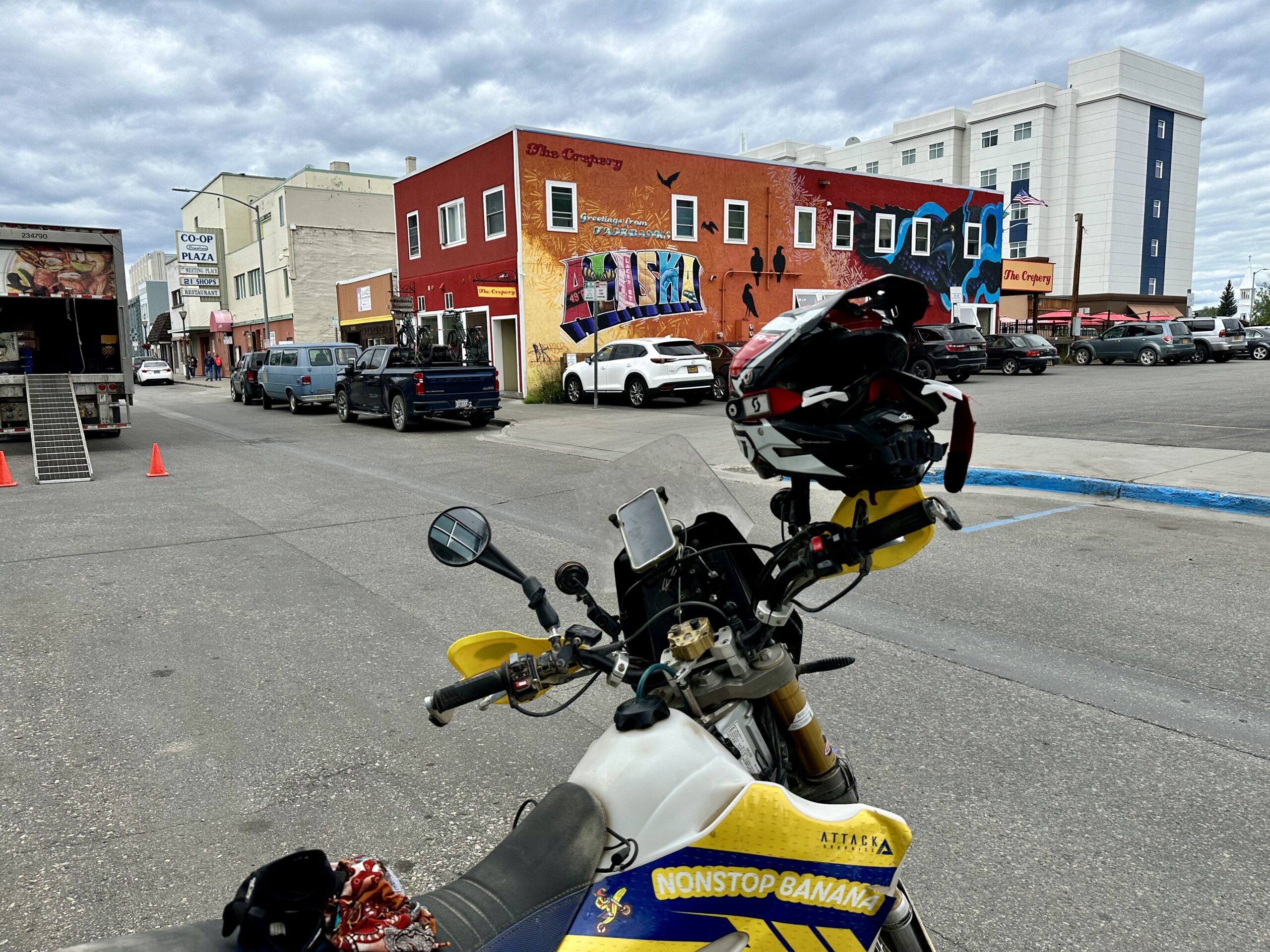
Taking advantage of the slowdown, we stayed a couple of extra days in Flagstaff. The city turned out to be more interesting than we anticipated, because frankly we didn’t anticipate anything at all. A college town, it has a fair share of all day brunch spots, late night pizza shops and quality street art. With Thanksgiving coming soon most of the shops were getting ready for festive season.


I will also have you know that it was in the Lowell Observatory in Flagstaff that Clyde Tombaugh discovered Pluto back in 1930. It’s been almost 20 years since it was demoted to dwarf planet, but it’s still a full planet to me. You can say it was that fateful resolution by the International Astronomical Union that led to my break up with astronomy as a career. It would be a retcon, but I’m not going to correct anyone who chooses to say that.

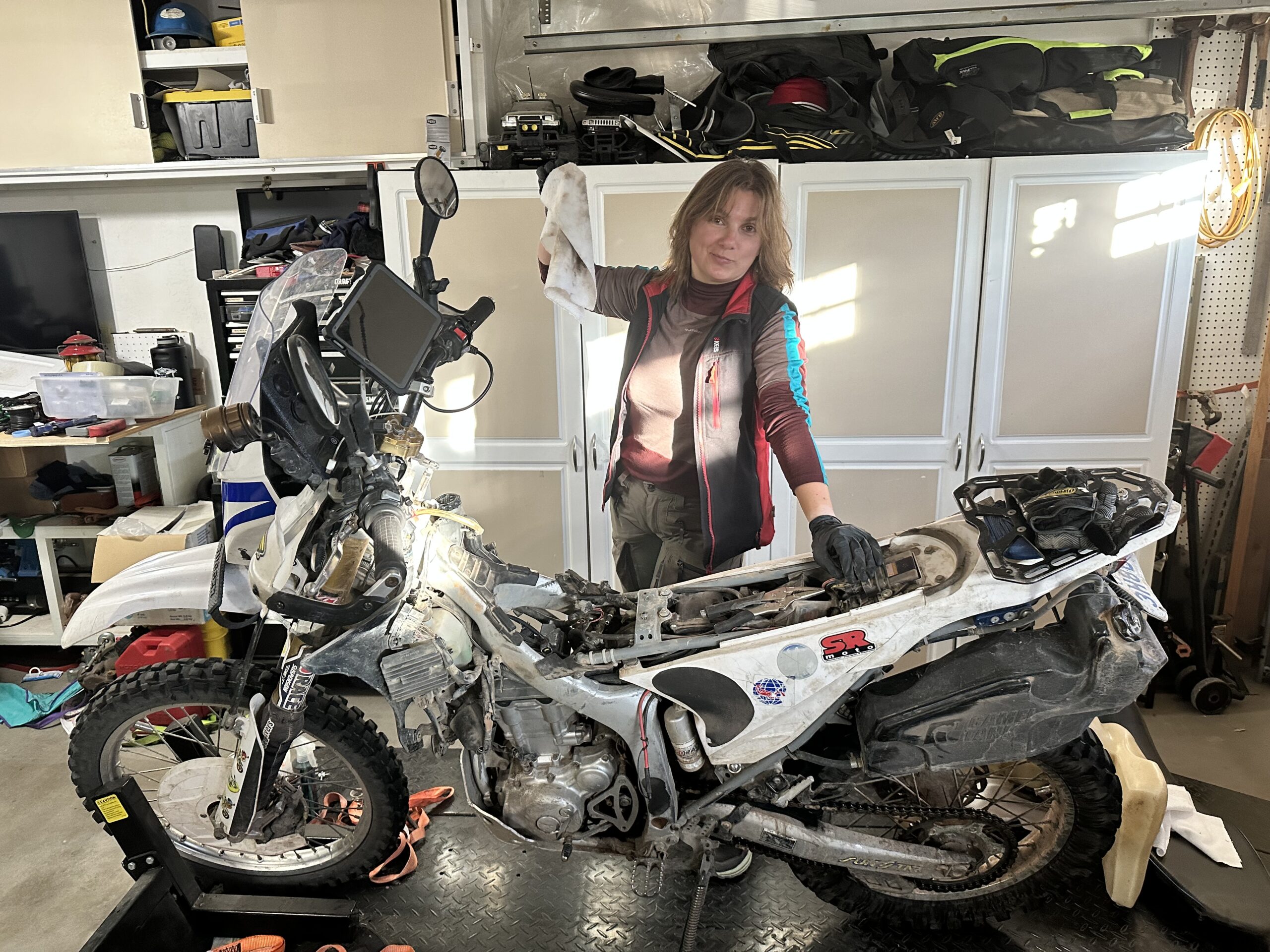
Our next relaxing stop was to visit a friend in Sedona and hike some of the surrounding red rocks. Lucky for her she did not have a workshop in her garage, else she’d wake up to find our engine in pieces all around. Instead, we waited until we were in a quiet Phoenix suburb, in a garage where a special place was set aside for this delicate work.
We joined our hosts for a Thanksgiving feast while the engine cooled off, and then proceeded to strip the bike until we could take off the head cover. As suspected, the same intake valve we adjusted less than a month prior was very tight again. It was clear that another shim will not do the trick.


The next morning we took the head off and the sequence of events leading to this predicament became apparent. Looking at the valves, even an untrained eye could easily detect that one of them was not like the others. One of the intake valves was missing a good chunk of its meat, I mean titanium. Why would that happen? Well, that story has its roots in Alaska.
When we rebuilt the engine with new OEM parts in Alaska, we only changed the piston and the cylinder, not the head and the valves. It didn’t seem necessary as they were not damaged and at most needed a bit of a cleaning. In retrospect, leaving the thin carbon build up alone would have been better.
Intake valves on Yamaha WR250R are made out of titanium, while the exhaust ones are steel. Yamaha engineers figured this set up allows a better balance between cost and performance, since intake valves need to be larger than exhaust and using costlier titanium saves weight. It also simplifies part sourcing, because all valves are able to use the exact same springs. The thing about titanium is that while its strength-to-weight ratio is excellent, its pretty soft compared to hardened steel, so to survive the life inside an internal combustion engine, the valves have a special coating that protects them from disintegrating. While generally the process of fitting a valve into an engine head involves lapping them (essentially rubbing them together so they fit tight without any gaps for air to leak through), if the valve is titanium, there is an extra step called “discard the valve used for lapping and install a brand new one instead”. That’s pricy.
Funny enough, many of the mechanics we’ve encountered along the way were unaware of this property of titanium valves. I guess they don’t read manufacturer service manuals. When we wanted to clean the valves and cylinder head in Alaska, we were missing the tool required to take them apart. After some searching, we found a shop eager to help, except the mechanic was confident that instead of using the proper tool (which was sitting on his table), he used a hammer. It was a classic “hold my beer” moment, as his first attempt resulted in a big fat nothing, while his second attempt resulted in parts flying all around the cluttered shop floor. This should have been a red flag.
After 40 minutes all the tiny missing parts were located, but the ordeal was not over. The mechanic insisted that gently scraping the carbon buildup by hand using a plastic spatula was not acceptable. Let me put that in a sand blaster, he said. It’ll be fine, he said. But sir, this is titanium, the coating would be damaged by sand blasting. I am a professional, these are special glass beads and nothing would be damaged, he said. I know what I’m doing, he said.
And so it has come to this.
Although we ordered a brand new cylinder head, we still entertained the idea of fixing the old one. After checking with numerous shops we found one skilled in exactly this kind of job: they could take a damaged cylinder head and cut a new seat for the valve that’s exactly the same shape as the original, just sitting a tad bit deeper. After examining our engine the lead mechanic felt confident the damage was superficial enough that it could be fixed. Armed with these possibilities we checked the shipping times for the remaining parts and buckled in for a couple of weeks off the bikes.